Idealisme betekenis filosofie

Idealisme is de verzamelnaam voor een aantal verschillende filosofische stromingen en standpunten, die de afhankelijkheid van de werkelijkheid van het bewustzijn benadrukken. Er kan onderscheid gemaakt worden tussen ontologisch (of metafysisch) idealisme en epistemologisch idealisme. Idealisme is een benaming voor een aantal filosofische stromingen die met elkaar gemeen hebben dat ze alles tot een geestelijk beginsel willen herleiden. Aan de uiterlijke objecten wordt dus geen zelfstandigheid toegeschreven, terwijl alleen wat in de geest is - de ideeën en grondbegrippen - werkelijkheidswaarde heeft.
Idealisme betekenis filosofie Wat is idealisme? Dit is een theorie die uitgaat van het kennend subject en zijn ideeën in relatie tot de buitenwereld. Het doel is om antwoord te geven op de vragen: Hoe kunnen de dingen om ons heen gekend worden? Hoe weten mensen? In die zin hebben we te maken met een gnoseologisch idealisme dat nadenkt over kennis en haar mogelijkheden.
idealisme betekenis filosofie

Filosofische idealisme

Idealism in philosophy, also known as philosophical idealism or metaphysical idealism, is the set of metaphysical perspectives asserting that, most fundamentally, reality is equivalent to mind, spirit, or consciousness; that reality is entirely a mental construct; or that ideas are the highest type of reality or have the greatest claim to being considered "real". Idealism, in philosophy, any view that stresses the central role of the ideal in the interpretation of experience. It may hold that the world or reality exists essentially as consciousness, that abstractions and laws are more fundamental than objects of sensation, or that whatever exists is known through and as ideas. Filosofische idealisme 1. Introduction. The terms “idealism” and “idealist” are by no means used only within philosophy; they are used in many everyday contexts as well.
filosofische idealisme

Plato idealisme

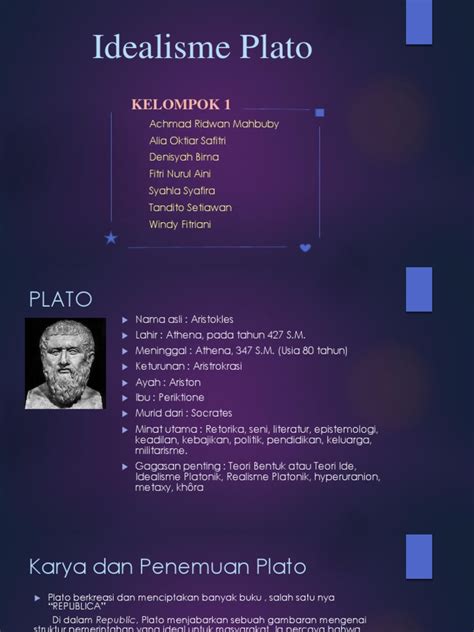
Idealism, as defined by Plato, is a philosophical concept that challenges the notion of physical reality. In ancient Greek philosophy, Plato argued that the physical world we perceive with our senses is not the only reality. If one believes in the non-conventional reality of normative facts one might also be drawn to idealism in order to account for their non-physical reality—Plato’s idealism, which asserts the reality of non-physical Ideas to explain the status of norms and then reduces all other reality to mere simulacra of the former might be considered a.
  • Plato idealisme Plato's idealism posits a realm of perfect forms separate from the physical world. Understanding ideal forms is central to achieving true knowledge, according to Plato. Plato's legacy influences how reality and cognition are conceived in philosophy.
  • Plato idealisme

    Wereldbeeld idealisme

    Tegenover het materialisme stelt Kastrup een ander wereldbeeld: het objectief idealisme. ‘Dat stelt dat er niet een fysieke én een mentale wereld is, maar alleen een mentale: één groot bewustzijn vormt de grondslag van de realiteit. De materiële wereld die we zien en meten is slechts een afbeelding van die ene fundamentele geest. De belangrijkste soorten filosofisch wereldbeeld: idealisme en materialisme. Ze ontstonden bij het aanbreken van de mensheid. Het idealistische wereldbeeld beschouwt het ideale principe als het belangrijkste principe van de wereld: spirituele, mentale, mentale fenomenen.
  • Wereldbeeld idealisme Volgens het idealisme zijn de tafel en de stoelen die je waarneemt alles wat er is, de gehele werkelijkheid. Een belangrijke conclusie die we moeten trekken uit het idealistisch wereldbeeld is: als het idealisme correct is, dan bevindt de geest zich niet in de materie, maar de materie bevindt zich in de geest.
  • wereldbeeld idealisme

    Subjectief idealisme

    Subjective idealism is a fusion of phenomenalism or empiricism, which confers special status upon the immediately perceived, with idealism, which confers special status upon the mental. Subjective idealism, a philosophy based on the premise that nothing exists except minds and spirits and their perceptions or ideas. A person experiences material things, but their existence is not independent of the perceiving mind; material things are thus mere perceptions. The reality of the.
  • Subjectief idealisme Author: Addison Ellis Category: Historical Philosophy, Metaphysics, Epistemology Word Count: Editor’s Note: This essay is the first of two essays in a series authored by Addison on the topic of philosophical idealism. Part 2 on Kant's Transcendental Idealism is here. We often take it for granted that we have some knowledge about the way.
  • subjectief idealisme